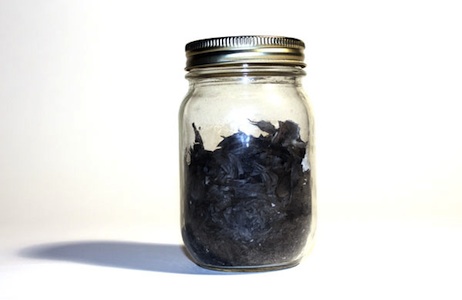
 Ashes represent death. They tell of the end of something that has been destroyed with unquenched fire, changing its very nature into tiny particles of unrecognizable dust. What once was, is permanently no longer. The end. A pile of death. Ash. Dust. Nothing.
I admit, there are parts of my life that have been reduced to ashes. I keep these losses in little jars on the shelves of my heart. Relationships that ended. Friends who died. Opportunities I wasted. Unanswered prayers. Failures. Sufferings of others. Actually, there’s currently a whole shelf just devoted to that one — ashes that represent people I love suffering from cancer, chronic illness, tragic accidents, abuse, divorce, rebellion, pain.
Ashes remind me that this world is broken. And that I cannot fix it. And that makes me mad. I’ve also been storing up boxes of questions in my heart, right next to the jars of suffering. Doubts I dared not entertain, burdens I shouldered alone, punches I was afraid to throw.
During this extended sabbatical I’ve been tackling some of the my compartmentalized questions. A book called “Glorious Ruin” by Tullian Tchividjan has changed how I process suffering:
“God, according to the Bible, is a God who suffers with us and who, in the person of Jesus, suffered for us. He’s the man of sorrows. If we needed any proof whatsoever that God is most present in defeat, that God is most present in weakness, all we have to do is look at the cross. When embraced, the cross actually frees us to be real, to be honest, to be Christian Realists instead of Christian Idealists. It frees us to call a spade a spade — to say, this suffering is terrible, and this isn’t the way things were intended to be. It frees us to look forward to the day when every tear will be wiped away, and death and disease will be no more.”
Ashes are literally a pile of loss. The physical representation of the nothingness of dead dreams and hopes and loves. Maybe that’s why Jesus said He was coming to redeem and restore not just “mostly dead” but “completely dead.” Ashes. The absolute nothing. If he can do the impossible in resurrecting ashes, is there anything He cannot do? Jesus speaks hope across time through the prophet Isaiah when He says:
“The Spirit of the Sovereign Lord is on me,
because the Lord has anointed me
to proclaim good news to the poor.
He has sent me to bind up the brokenhearted,
to proclaim freedom for the captives
and release from darkness for the prisoners,
to proclaim the year of the Lord’s favor
and the day of vengeance of our God,
to comfort all who mourn,
and provide for those who grieve in Zion—
to bestow on them a crown of beauty instead of ashes,
the oil of joy instead of mourning,
and a garment of praise instead of a spirit of despair.”
God likes the nothingness of ashes because it gives Him exclusive rights to the glory for redeeming them. I so badly want to help fix things and reconstruct dust particles; the helplessness of ashes frustrates me. But Jesus came to free me from the burden of having to be the world’s redeemer. Simply put, I can’t do it. And, as frustrating as that is, it’s actually really good news. I am only responsible to point the world to Jesus, our only hope.
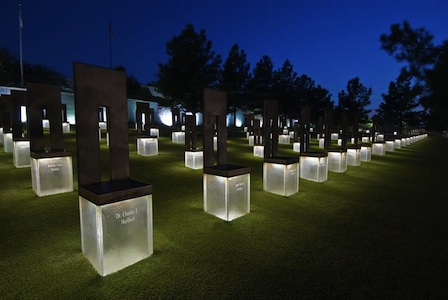 While in Oklahoma this summer I visited the national memorial for the Oklahoma City Bombing. A field of chairs overlooks a reflecting pool with each seat representing one of the 168 people killed that day — 19 of them children. You’ll also find the remnant of a broken wall, a fence with notes from the public and many somber spaces for remembering those who died, those who survived and those who rushed in as rescuers. Walking around the memorial I sensed deep grief and fear and anger, all begging the world to never forget the unthinkable, senseless intrusion of evil. My heart was broken.
Just as I thought I couldn’t process anything else, I saw The Survivor Tree. This American Elm witnessed the horrific events of April 19, 1995 and all the unimaginable tears since then. And yet it stands. It survived. Not only is it alive, but it is flourishing. Tall, full and strong it provides shade to grieving pilgrims and hope for weary mourners. It says, “it’s going to be okay. You’re going to make it.” Without ceremony or arrogance it reminds us that life can go on.

I spent several minutes under The Survivor Tree. I rested my hand on it’s trunk and thought of all the people I know who are currently struggling to survive various tragedies in their lives. Over and over in my head I heard the words, “beauty from ashes.” The Spirit of God was giving me a vivid image of how He came to redeem death, restore hope and create life. Just like The Survivor Tree, we will live as a testimony to all who see us.
This past year I’ve come to accept suffering. My next goal is to be grateful for it. And maybe one day I will even get to the point of embracing it. And while I am not there yet, I am learning why I need to pray towards that end. Author Ann Voskamp says this:
“We may all want anything other than suffering and ashes. But this is a dust-crushed world and Christ didn’t avoid it but chose to come to it. Why embrace dust and ashes? Because it’s out of dust and ashes, God grows the impossible. Because God exchanges dust and ashes for beauty and miracles and He cares so much that He doesn’t care that it’s not fair. Because God raises whole people out of ashes and He writes mysterious grace in dust, and with Him, dust and spit and muddied things can still help us see.”
And so, surrounded by jars of ashes and my boxes of questions I am learning to look for Jesus amid my sufferings and sorrows. He came to bring comfort and purpose; I must learn to let Him into these heart-closets so that He can do His redemptive work. It’s a step of trust. Of faith. Of vulnerability.
But what do I have to lose? I can’t get anything less than ashes. I believe that these jars of nothingness will be redeemed in God’s perfect time. He is writing mysterious grace in the dust of my life.
“All this pain
I wonder if I’ll ever find my way
I wonder if my life could really change at all
All this earth
Could all that is lost ever be found
Could a garden come up from this ground at all
You make beautiful things
You make beautiful things out of the dust
You make beautiful things
You make beautiful things out of us”
–“Beautiful Things” by Gungor
 Into Beautiful Places